Safe 3D Printing Workshop

Safety in 3D Printing
The number of 3D-printed firearms recovered by the New York Police Department soared from just four in 2022 to over 100 in 2024. These are ghost guns manufactured outside the standard firearm dealer process, meaning they are acquired without a criminal background check and they can’t be traced if they are found at crime scenes. If they don’t have metal parts, they may be invisible to the metal detectors in many schools, theaters and airports. And the public safety threat from 3D printing extends beyond traditional firearms to easily printed “machinegun conversion devices” (MCDs): small plastic parts, visually similar to benign objects, that convert semiautomatic handguns into fully automatic weapons firing at a rate of 1,200 rounds per minute. As printer technology has rapidly improved and prices have fallen in recent years, DIY gunmaking is suddenly broadly available—with dangerous consequences. This year, New York and California enacted new laws to address this growing threat, mandating that 3D printer makers embed firearm- and MCD-blocking technology into their printers.
This afternoon explores the question of 3D printed firearms from a public health, engineering, legal and social perspective. Solomon Diamond (Dartmouth College) will introduce SafePrint, a consortium which brings together legal experts, engineers, academics and corporate members of the 3D printing industry. Victor Cardona, a former NYPD detective and security consultant, will speak on the dangers of 3D-printed firearms; Charles Branas, from the Columbia Scientific Union for the Reduction of Gun Violence (SURGE) on firearm violence from a public-health perspective; Thomas Chittum (Chittum Law) on the current law around 3D-printed guns; and Everytown for Gun Safety, a national gun-violence-prevention non-profit, on recent legislative efforts on the 3D-printing of guns. Silvia Sellán (Computer Science, Columbia) will close with the technology of detecting 3D-printed firearms.
This event is hosted by the DSI Data, Media and Society Center.
Details & Registration
Thursday, November 5, 2026 (2:00 PM - 4:30 PM)
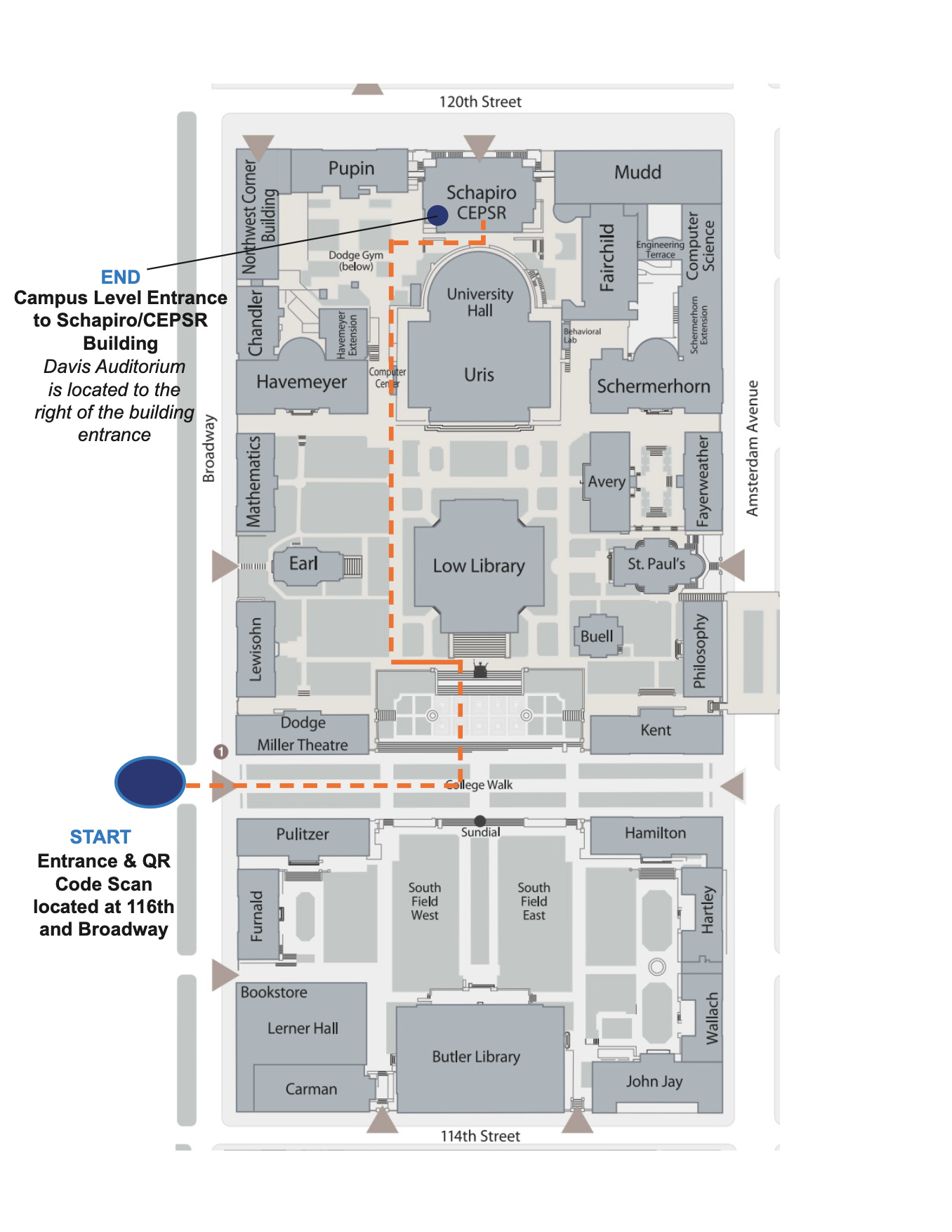
Davis Auditorium, CEPSR (4th Floor - Campus Level) - Campus Map
Speakers
Silvia Sellán is an Assistant Professor in the Computer Science Department at Columbia University. She specializes in computer graphics and geometry processing; in particular, her research focuses on implicit shape representations and surface reconstruction. She received her PhD from the University of Toronto, and worked as a postdoctoral researcher at MIT. At Columbia, she directs the Geometry and the City laboratory. She is also co-chair of the Data, Media, and Society center of the Columbia Data Science Institute, and the Computer Science advisor for the Dual M.S. in Journalism and Computer Science.
Eugene Wu develops systems and algorithms for modern interactive data analysis.
His research focuses on the full interactive data analysis stack: from data cleaning and preparation, to scalable systems for interactive exploration interfaces, to automatic interface generation, to explanation tools that help explain anomalies encountered during data analysis. His current project is the Data Visualization Management System, which integrates concepts from database research, such as declarative languages, query optimization, and lineage, with interactive visualizations, making it easier to design, architecture, build, and scale rich visual data exploration systems.
Wu’s research spans the areas of core database optimization, stream processing systems, crowd sourcing, data visualization, data cleaning, and HCI. His work includes SASE, one of the first high performance complex event processing systems for high throughput data streams; Scorpion, which introduced a novel analysis feedback system that explains anomalies that analysts find in data visualizations; ActiveClean, the first interactive data cleaning algorithm designed for data science; and Precision Interfaces, the first large-scale automatic interface generation system. His current work in data visualization management systems draws connections between data visualizations and data processing systems and unifies them under a single system abstraction. The interdisciplinary nature of his research leads Wu to work closely with researchers in information visualization, perception, theory, and machine learning.
Wu received a BS in electrical engineering and computer science from UC Berkeley in 2006, a PhD in electrical engineering and computer science from MIT in 2015, and was a Postdoctoral Fellow at UC Berkeley in 2015.
Solomon G. Diamond, Associate Professor of Engineering, Dartmouth College
Bio coming soon
Victor Cardona, Co-Founder and Chief Operating Officer, LNC Security Consulting
Bio: Victor B. Cardona is a US Marine Corps veteran, former NYPD detective, and founder of LNC Security Consulting. During his over twenty year tenure with the NYPD, he founded and led their Major Case Field Intelligence, “Ghost Gun”, Team, which was instrumental in crafting the national model for identifying, detecting, deterring, and investigating personally manufactured firearms and 3D-printed weapons. Today, as leader of LNC, he works to ensure organizations and communities are equipped to confront these evolving threats with clarity and precision.
Charles Branas, Gelman Professor and Chair, Department of Epidemiology, Columbia University Mailman School of Public Health
Bio: Dr. Branas leads one of the nation's oldest and largest Departments of Epidemiology and is known for his focus on especially challenging health issues and interventions that improve basic determinants of health, such as access to green space, housing, and medical care. He is the founding PI/PI of two CDC-funded research centers. His research has been cited by landmark Supreme Court decisions, Congress, and major news outlets, and he has mentored scientists into leadership posts ranging from top universities to the White House. He has worked at multiple Schools of Public Health, Engineering, and Medicine.
Thomas L. Chittum III, Attorney at Law, Chittum Law; formerly an Associate Deputy Director in the Department of Justice (retired, May 2022)
Bio: Tom Chittum is a private attorney specializing in firearms law, the Second Amendment, criminal justice issues, and public safety technology. He proudly served the United States for nearly 27 years, retiring from the Department of Justice as Associate Deputy Director of the Bureau of Alcohol, Tobacco, Firearms & Explosives (ATF). He is also an Adjunct Law Professor at UNLV’s Boyd School of Law. He is licensed to practice law in Virginia, West Virginia, and Kentucky.
Jonas Oransky, Senior Director, Legal, Everytown for Gun Safety
Bio coming soon
Agenda
Thursday, November 5, 2026
2:00 PM: Welcome and Introductions (10 min)
- Silvia Sellán, Assistant Professor of Computer Science, Columbia Engineering
2:10 PM: Introduction to SafePrint (15 min)
- Solomon G. Diamond, Associate Professor of Engineering, Dartmouth College
2:25 PM: The Dangers of 3D-Printed Firearms (25 min)
- Victor Cardona, Co-Founder and Chief Operating Officer, LNC Security Consulting
2:50 PM: Break (10 min)
3:00 PM: Firearm Violence from a Public Health Perspective and Introduction to SURGE (30 min)
- Charles Branas, Gelman Professor and Chair, Department of Epidemiology, Columbia University Mailman School of Public Health
3:30 PM: The Current Law Around 3D-Printed Guns (20 min)
- Thomas L. Chittum III, Attorney at Law, Chittum Law; formerly an Associate Deputy Director in the Department of Justice (retired, May 2022)
3:50 PM: Current Legislative Efforts on 3D-Printed Gun Regulation (20 min)
- Jonas Oransky, Senior Director, Legal, Everytown for Gun Safety
4:10 PM: Technology for Detecting 3D-Printed Firearms (20 min)
- Silvia Sellán, Assistant Professor of Computer Science, Columbia Engineering
4:30 PM: Event Ends
FAQs
Campus Access for External Guests: The Columbia Morningside campus is open to the Columbia community. If you do not have an active CUID, registration is required. The deadline to register is at 12:00 PM the day before the event. External guests will receive a QR code by email to enter campus.