AI and the Race to Map the Ocean's Microbes

Today, the Morningside Park pond looks like a pleasant urban waterway, home to wildlife and an idyllic-looking waterfall. But in 2024, its waters were stagnant and choked by algal blooms that prompted a collaborative intervention by Columbia researchers, community partners and New York City’s Department of Parks & Recreation. While algal blooms are not always harmful, understanding their trajectories is crucial to maintaining healthy aquatic ecosystems–and highlights the critical role that microscopic organisms play in the global environment.
Microscopic Plants, Global Impact
In the ocean, phytoplankton—which are microscopic saltwater algae—have long played a crucial role in the global carbon cycle, accounting for over half of the Earth's annual photosynthetic oxygen production. These single-celled organisms harness sunlight to convert carbon dioxide into organic matter through photosynthesis, forming the foundation of aquatic food webs.
While some of the carbon from phytoplankton is ultimately incorporated into coral structures or the bony shells of other organisms and sequestered for long periods, not all plankton rely on sunlight alone. Zooplankton obtain energy by consuming phytoplankton, releasing CO2 in the process. Mixoplankton, meanwhile, can obtain energy from photosynthesis or from consuming phytoplankton, depending on their environmental conditions. Recent research suggests that in a warming world, mixoplankton may soon become net carbon emitters.
This possibility has lent urgency to the work of identifying plankton species and understanding the conditions in which their populations may thrive, decline or create harmful toxin levels in the waters they occupy. At Columbia University’s Lamont Doherty Earth Observatory, Joaquim Goes–who is also working on the Morningside Park pond project–is training computer models to recognize different types of plankton more efficiently and develop methods to predict outbreaks of phytoplankton blooms, which may indicate that broader environmental changes are underway. Tracking these shifts can not only help build a better understanding of how much carbon the ocean's plankton are likely to capture or release, but also how likely they are to create toxic blooms.
Automating Algae Classification with AI
Using FlowCAMs–an imaging system customized by researchers at Lamont-Doherty that captures high-resolution photographs of ocean water as it flows past a lens–Goes and his team have been able to automatically capture images of particles and plankton in ocean water from around the globe, amassing millions of records in the process.
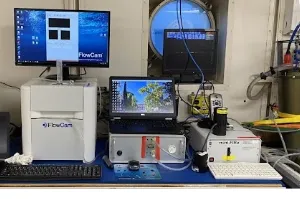
These images constitute a vast and valuable repository of marine plankton imagery. But this massive volume of data has also presented a new challenge: identifying and classifying the organisms in millions of images remains a painstaking, time-consuming task, traditionally performed by trained specialists examining individual samples under microscopes.
Goes and his research team have been working with students from the Data Science Institute to apply advanced computer vision and deep learning techniques to cluster groups of phytoplankton images based on features like color, shape and size. With the volume of imagery now far outpacing what specialists can review by hand, that automation has become essential. “AI can catch up and it can help segregate [the data] in a better way, instead of the biologist actually going and doing the actual work of segmentation,” said Yeshitha Bhuvanesh, a Computer Science student and research assistant in Goes’ lab.
Through the DSI Scholars program, data science master's student Adityaram Komaraneni also worked to develop a dashboard that allows researchers to upload batched image files, organize classifications and explore results alongside environmental measurements. The resulting Computer-Assisted Automated Phytoplankton Classification System (CAPCS) has dramatically accelerated the rate at which the researchers can analyze their large troves of imagery.
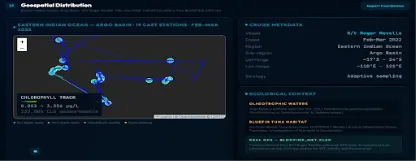
“We had this problem in the past where we couldn’t analyze the data," Goes said. "With machine learning tools and this dashboard that we’ve created, it’s going to be so much easier.”
Still, human review remains an important part of that process. While the system has a 98% top-three accuracy rate across 10 species classes—meaning the correct species is almost always among its top three guesses for those species—its overall accuracy rate is currently about 60%. To address this gap, a human taxonomist reviews the system’s suggested identifications, confirms correct predictions and distinguishes between similar species when the system is uncertain or produces an incorrect result. The combination of automated identification and expert review helps improve efficiency while preserving the quality of the final classification assignment.
From Surface to Satellite
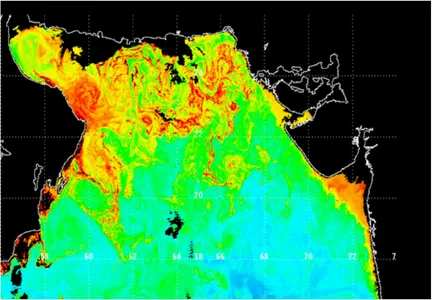
The potential applications of CAPCS extend beyond individual water samples. NASA’s Plankton, Aerosol, Cloud, ocean Ecosystem (PACE) satellite measures the light reflected from the ocean to help determine what phytoplankton species are present in the water and monitor how they change over time. The water samples collected at sea by Goes and his team are used to help verify those satellite observations, with the goal of confirming from the ground what PACE sees from space.
“Each of these phytoplankton have different kinds of pigments,” Goes said. "The light that the satellite can see is different from one species to the other.”
More efficient cross-validation of the satellite imagery could help researchers better understand harmful algal blooms, which can threaten aquatic ecosystems and fisheries. By making microscopic life in water easier to study, AI systems like CAPCS could help scientists better understand how aquatic ecosystems are changing, from an urban pond in New York City to the vast reaches of the world's oceans.
Lili Cortes Gutierrez is a 2026-2027 Journalism Fellow with the Data Science Institute.
Editing by Susan E. McGregor.