Wearables Offer Earlier Insights on In Utero Brain Development
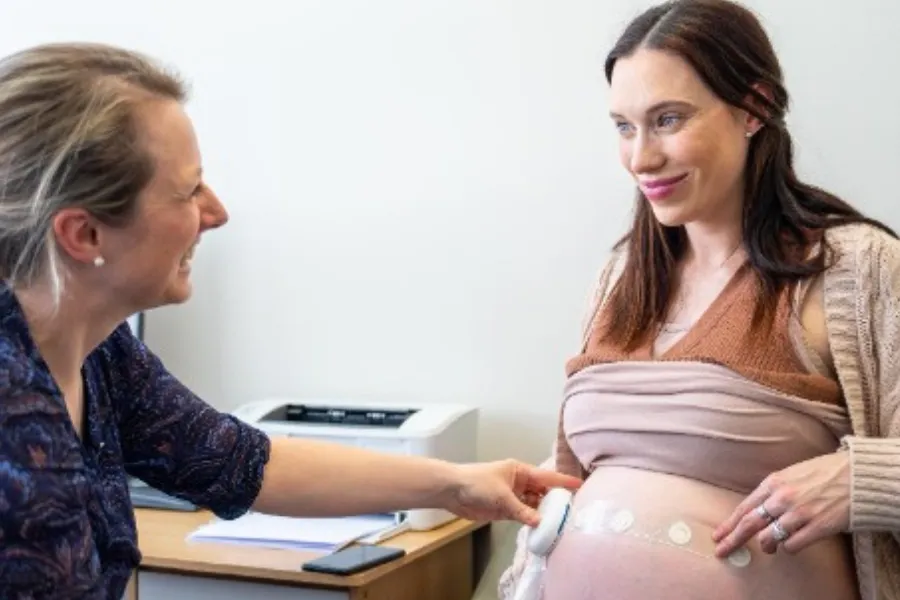
While expectant parents are often tempted to read into every kick and turn that can be felt during pregnancy, doctors and researchers typically have to rely on brief clinical measurements when trying to assess fetal development. Although more comprehensive data could potentially lead to earlier interventions and better outcomes, the tools to achieve this have been difficult to deploy, especially in rural and developing areas.
At Columbia University's Irving Medical Center (CUIMC), however, researchers are leveraging wearable technologies and unique analytical methods to identify how certain fetal behaviors reflect maturation of the developing nervous system. Isabelle Mueller, a postdoctoral researcher working with William P. Fifer, is investigating whether tracking these physiological patterns starting earlier in a pregnancy can provide an earlier window into fetal maturation, ultimately helping support better fetal and maternal outcomes both in the US and around the world.
Wearables: A Way to Expand Prenatal Care?
Even before a baby is born, its developing nervous system is showing signs of maturation that are reflected in its heart rate and sleep patterns, with distinct cycles of active and quiet sleep identifiable as early as 26 weeks. Prenatal active sleep is linked to sensorimotor development, while quiet sleep is believed to be important for processes including recovery and regulation.

Traditionally, fetal sleep has been studied during clinical assessments. But these typically last less than an hour–too short a period to observe potentially meaningful patterns in the fetus' transitions between active and quiet sleep. By placing a wearable device on the mother’s abdomen that can continuously record the fetal ECG for up to 24 hours, Mueller’s research is expanding what is known about these early stages of development.
“Very little research has looked at fetal physiology over extended periods of time,” Mueller said. “Now we actually can take this to a more naturalistic environment to learn a lot about the fetus.”
DSI Scholar Akanksha Dhar worked with Mueller to identify patterns across quiet-state and active-state heart rates that may reflect maturation of the neural systems involved in organizing fetal behavior. By combining fetal heart-rate variability with sleep-state transitions, Dhar's analysis also indicated that fetal sleep-state switching is not driven only by the mother’s heart rate, but reflects the fetus’ own developing regulatory processes as well. This supports the idea that these transitions reflect the fetus' own nervous-system maturation.
Deeper Insights from Prenatal Heart Rates
Although heart rate has long been understood as an important indicator of fetal health, there is still much to be learned about how it is affected across different exposures and populations.
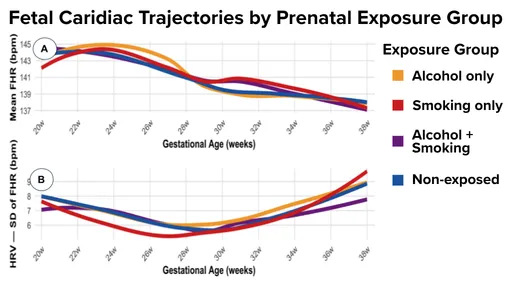
In related research, Mueller recently worked with DSI Scholar Aniqa Nayim to conduct a unique analysis of thousands of fetal heart rate recordings from across the U.S. and South Africa. Though pre-natal exposure to both alcohol and smoking are well-known to increase the risk of adverse outcomes, Mueller's work explores how early they might show an impact on the fetus.
“One of the most interesting questions about this is obviously the long-term problems that might be connected to exposure to smoking or alcohol in pregnancy and how early we might see risk factors,” Mueller said.
Through layered data analysis and visualization, Nayim's work examined how different combinations of pre-natal exposures are associated with different fetal heart rate patterns across both time and geographically distinct populations.
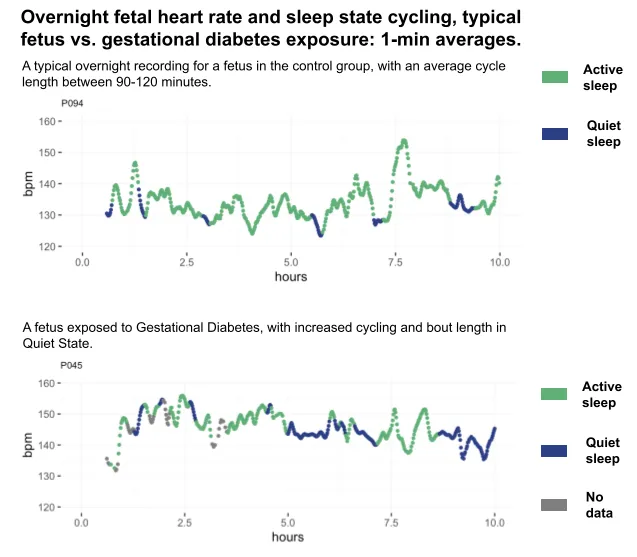
Similarly, the insights into fetal sleep cycling provided by wearables could also help provide early signals of developmental differences. For example, Mueller’s research indicates that exposure to gestational diabetes—which can increase risk of neurodevelopmental delays—decreases the time a fetus spend in active sleep.
“Studying fetal sleep cycling may provide an early window into emerging developmental differences,” said Mueller. “This might help us identify when developmental differences first emerge, and periods when intervention might be most effective."
Lili Cortes Gutierrez is a 2026-2027 Journalism Fellow with the Data Science Institute.
Editing by Susan E. McGregor.