AI in Sports: Where Data Meets Human Expertise

"Our job is not to build AI-perfected baseball; our job is to make actual baseball better.”
Will Edmondson, Senior Vice President of Business Analytics and Operations at Major League Baseball (MLB), knows what it means to balance one of the United States’ oldest pastimes with cutting edge technology. On September 9th, he joined Columbia Business School professor Mark Broadie and Joanna Levy, Vice President of Analytics for DraftKings, to share some of the ways MLB and its 30 Clubs across the country are leveraging AI on and off the field. The event was the first in a series of nine Data and AI Exchange (DAX) INSIGHTS events that DSI will host to explore how responsible AI is being implemented across various industries. Below are key takeaways from the conversation.

Takeaway 1: Maintaining a culture of innovation and iteration
“Part of the value of AI to us is being able to test and learn and fail–and fail quickly," Edmondson said. “Everything's iterative.”
MLB needed actionable insights around why some social media posts performed better than others, and about which players received the most interest on social media. Because MLB and its Clubs across the United States have hundreds of social media accounts posting multiple times a day, the task was daunting without AI. The organization saw an opportunity to build a dedicated AI model with capability to label and track these posts’ performances, saving dozens of hours of labor and enabling MLB to reach actionable insights much faster than if a team member were charged with these time-consuming tasks.
“The first model, we got 70% of the way there, and we felt really good about it. Then we started looking at what the model got wrong, and we realized that there are some pretty obvious issues.” Edmondson explained the model often didn’t have enough context to label their photos. “To try to address this, we updated the model to hook into our baseball stat system.”
The second version of this model was significantly more accurate, and continues to save MLB time and effort so they can share information that resonates most with fans. Edmondson explained that, even before the advent of AI, MLB’s culture embraced the value of constant innovation and testing. Now with AI, they can build and test more efficiently.

Takeaway 2: Make improvements while keeping the human interest
Edmondson explained that MLB’s approach to AI is to use it to improve existing and imperfect systems, while keeping the elements that fans connect with.
To illustrate this balance, Edmondson shared findings from MLB’s fan research and testing on the Automated Ball-Strike (ABS) system, which is new this season. During testing the system in prior Minor League seasons, fans preferred to keep human umpires, and allow Clubs a limited number of challenges to their calls. Edmondson explained that fans preferred that outcome over using ABS alone, in lieu of a human umpire, because the umpire is an essential element to the baseball audience and to the drama of a game. It was too pivotal to the fan experience to turn over entirely to technology. And as an added benefit, integrating the ABS Challenge system has added a strategic element to Clubs’ game planning.
“Fans don't want to go see a perfectly articulated, perfectly optimized version of baseball. They want to see a human game, and they want to argue with the umpire, and they accept and expect a level of friction,” Edmondson said.
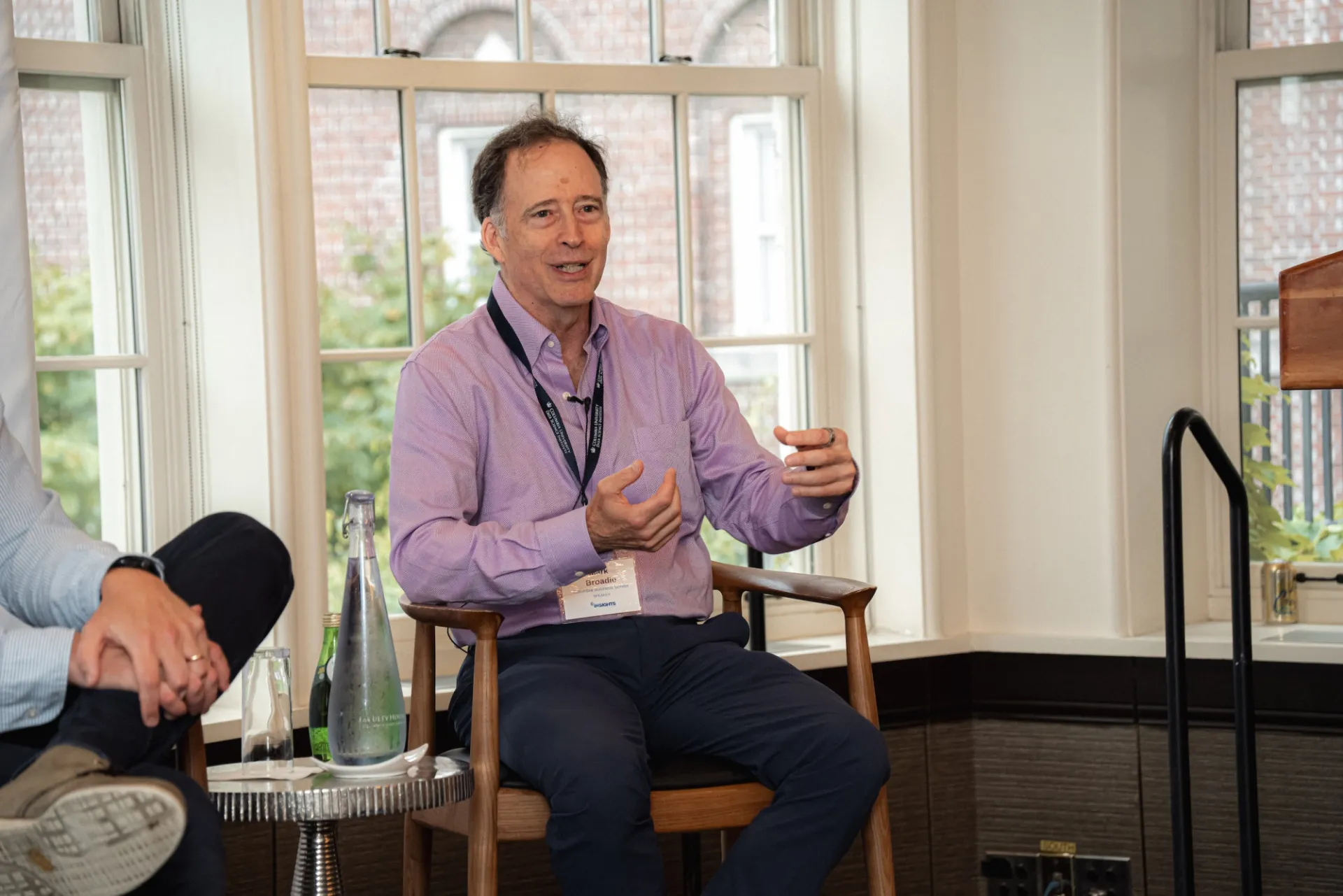
Following Edmondson’s keynote, he was joined by two sports analytics experts for a fireside chat with Mark Broadie, Columbia Carson Family Professor of Business Decision, Risk, and Operations, and Joanna Levy, Vice President of Analytics for DraftKings, who moderated the panel. Levy’s questions focused on the ways AI is being implemented across sports analytics, particularly professional golf, a sport in which professor Broadie has been deeply involved throughout his career. He spoke to how AI is being implemented in that sport.
Broadie echoed Edmondson, saying AI can be used to create and analyze data in new ways, for example, a 3D scan of a golfer’s swing. But he emphasized the enduring need for human expertise and experience. “I can see AI helping coaches in the way that trackplates and videos have helped coaches,” said Broadie. “But I don’t see it replacing coaches.”
Takeaway 3: Soft skills and relationship building remain pivotal
In his keynote and throughout the Q&A portion, Will Edmondson and professor Broadie underscored how crucial soft skills remain in sports analytics. Edmondson explained that while people often ask him questions that could be answered with data, their real question is often deeper, and he has to interpret why they’re posing the question. “Soft skills are underrated,” he said. “Looking someone in the eye, having them trust you. Those are the types of things that I think are incredibly important, and will continue to be in the next few years.”
Edmondson’s message for the students in the audience was to use AI to advance their education, but still put in the work to understand their field. “If you are fast forwarding with an AI-driven solution, and you haven't put in the work to get there, you're going to get a follow-up question that you don’t know how to answer.” He likened school to sports, saying “training and doing the reps and the repetition is hard, but it's supposed to be hard.”
Professor Broadie had a message for the industry and academics in the audience who are tentative about embracing AI. He closed his remarks by encouraging them to “lean into AI, don’t put your head in the sand. Your competitors are using it.”
This event was the first in a series of nine forums that showcase how AI is being implemented in certain areas across various industries. “AI has applications in nearly every field right now. We’re interested to see how it is being used in sports to help the players and improve the fan experience,” said Lori Glover, Chief of Strategic Alliances at the Data Science Institute (DSI), and host of the DAX INSIGHTS forum. “I hope events like these continue to foster connections between industry and academia by highlighting areas of alignment where expertise, priorities and opportunities intersect.”
Explore the DAX INSIGHTS Series and register your interest to attend future events at the link below.