Columbia's NSCORE: Bringing "Synthesis Science" to Organismal Biology
In her research exploring how an organism's environment influences its immune function, Dr. Cynthia Downs has often had to contend with the challenges of obtaining high-quality field data. Intricate physical factors such as how a sample is collected, how it is preserved–and for how long–all affect the types of investigations she can successfully conduct.
At the same time, Downs, an associate professor at the State University of New York College of Environmental Science and Forestry, understands the potential that data and AI tools have for her research. While computational approaches can help moderate some of the complexities of fieldwork, they often pose a different challenge: building the right research partnership.
“As a biologist, I’m looking for a computer scientist who’s excited about biological questions, and those people are not super abundant in my general circle,” Downs said. “And then when they do go to biology meetings, they’re incredibly in demand, which can make it hard to build a relationship.”
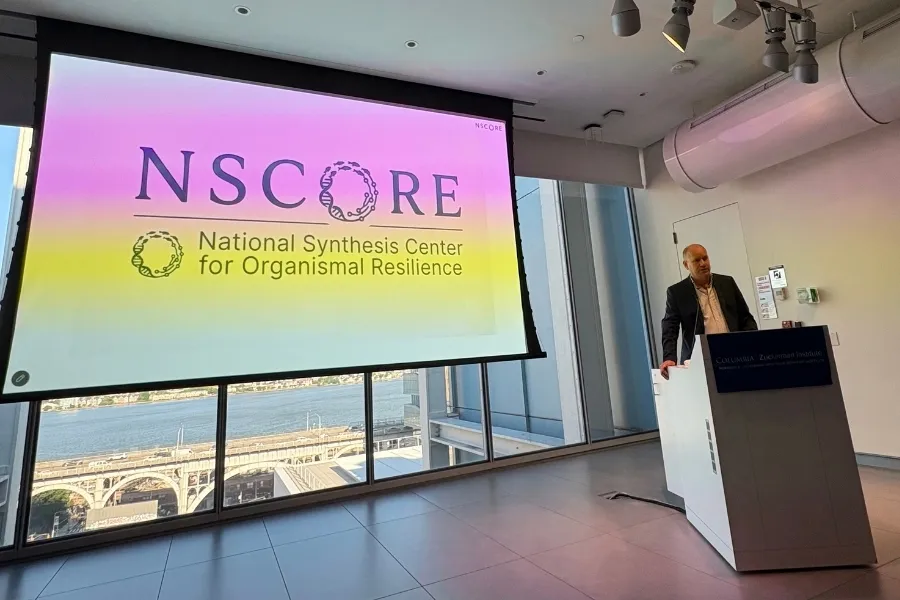
That challenge was part of what brought her to Columbia University's Manhattanville campus on September 14, 2026 where she attended a day-long research symposium marking the launch of a new, interdisciplinary research center designed to foster collaboration between computational experts and organismal biologists.
In collaboration with Columbia's Data Science Institute, the new National Synthesis Center for Organismal Resilience (NSCORE) will support the "synthesis science" that is so crucial to advancing organismal biology. It will also facilitate research connections with institutional partners, including the New York Botanical Garden, the American Museum of Natural History in New York City, the Max Planck Institute of Animal Behavior (MPIAB) in Germany and Academia Sinica’s Biodiversity Research Center (ASBRC) in Taipei, Taiwan. NSCORE will also leverage a dedicated physical space in Uris Hall on Columbia’s Morningside campus to enable collaboration.
“I know some people said, 'We speak different languages' and that’s true,” said Florence Hudson, NSCORE’s director of education, outreach and engagement. “ Some speak of microbiomes. Others speak of petaflops, AI and data. Together we will build a community for the integration of these domains to enable computational organismal biology globally.”
As Dr. Alex Jordan's presentation on animal behavior highlighted, robust interdisciplinary partnerships can support truly unique scientific advances.
Through AI-based tracking and image analysis, Jordan and his team developed novel approaches to capturing the movements of freshwater fish in the wild, including their postures and interactions over time. While the volume of new data this generated was exciting, it quickly became both too large and complex to manage and analyze manually. By applying the right computational approaches, he and his collaborators were able to reduce the high-dimensional information into an interactive visual "nebula" that could be used to identify previously unmapped behaviors.
For Hudson, Jordan's work—especially his use of conceptual frameworks, theories, and analytical approaches from various disciplines—exemplifies the kind of work that Columbia's NSCORE center can support. "That’s one of the opportunities that I think we have across multidisciplinary science," she said.
While Downs initially saw computational expertise as a way to help her model existing research questions, attending the NSCORE symposium shifted her thinking. After the event, she began thinking about AI less as a tool for making current tasks faster and more as a way to expand the types of scientific questions she can explore.
That change in perspective is precisely what NSCORE’s executive director, Dr. Dustin Rubenstein, believes the center’s work can foster.
“As we start to train biologists in some of these tools, as we start to educate some of the computer scientists in some of this knowledge, we hope they can work together to answer new questions that a few months before they didn't even know they could ask,” Rubenstein said.
Lili Cortes Gutierrez is a 2026-2027 Journalism Fellow with the Data Science Institute.
Editing by Susan E. McGregor.