Securing COVID Research Insights for Future Resilience
A new volume edited by DSI’s Florence D. Hudson helps ensure that cross-disciplinary insights from publicly-funded COVID-19 research will remain accessible to the next generation of researchers.

In early 2020, as the COVID-19 pandemic upended expectations and daily routines around the world, researchers and health agencies quickly focused their work on generating findings about how best to respond to both the virus itself and its broader societal impacts. Novel funding and dissemination methods led to a tremendous increase in the volume of research being conducted, with new communication technologies and the urgency of the moment leading to new collaborations and discoveries. In the US, many of these efforts were supported by two of US governments’ primary scientific funding agencies: the National Science Foundation (NSF) and the National Institutes of Health (NIH). Over the years, these agencies funded thousands of pandemic-related scientific investigations, generating valuable analyses into subject areas from fundamental biology to public health, education, and mobility. As is often the case with academic research, however, ensuring its impact extended beyond university researchers and disciplinary experts remained a challenge.
Fortunately, leading Data Science Institute (DSI) researchers quickly recognized and responded to that challenge. In May 2020, former DSI Director Jeannette Wing and Florence Hudson, Executive Director of the Northeast Big Data Innovation Hub (NEBDHub) at DSI, were awarded funding to create the COVID Information Commons (CIC), an open-source online platform that provides information and insights from over 14,000 NSF- and NIH-funded research initiatives related to COVID-19.
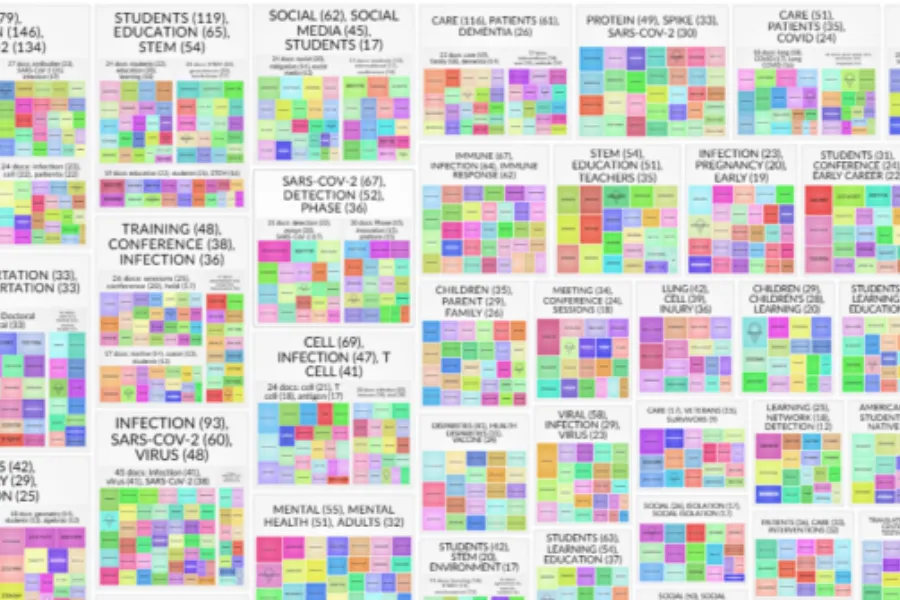
But the CIC is more than simply an index of academic research awards. Through its COVID Research Explorer tool, visitors can quickly see an overview of projects clustered by subject area, allowing researchers to quickly identify key perspectives and possible collaborators. It also provides access to relevant datasets, research publications, and organizations. Perhaps most importantly, however, the CIC hosts informative lightning talks where researchers provide accessible observations and takeaways from their work. These 5-10 minute video presentations–all of which have been transcribed into English, Spanish, French, and Hindi–have also been archived via Columbia University’s Academic Commons, ensuring that they can be properly cited (each transcript has a unique DOI) and will be preserved into the future as part of the University’s archival record.
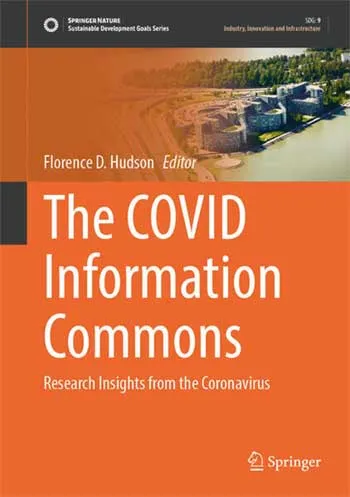
Despite the robustness of this effort, Hudson was looking for new ways to ensure that publicly-funded pandemic research intelligence would be as accessible and durable as possible. “We wanted to document it for posterity, so it’s always available,”/ Hudson says. Though it may seem traditional, publishing an edited volume was another way to ensure the longevity of the research insights.
“When you have a website, you know, the website might go away, the institution might change, the people might move to a new institution,” Hudson points out. “We wanted to document it for posterity, so we thought publishing it with ‘Springer Nature’ would be a good way to do that.”
Although designed for posterity, the focus of the new volume is decidedly forward-looking. When she was working with the contributing authors, Hudson says, “Each chapter had to include a few things: The goal of your research, why you chose that goal, and the results.” Most importantly, she said, it had to include recommendations to mitigate future pandemics.
“That’s the real reason for it,” says Hudson. “What did we learn, and what should we do?”
The result is a volume full of unexpected–and actionable–realizations for practice areas ranging from crowd management to prenatal care. For example, one research group looked at airline boarding practices. “Different airlines allow boarding in different ways,” says Hudson. “Either they spread you across the plane, or they put you in a pod together.”
“The researchers actually talk about how transmission rates differ, depending on how you do boarding.”
Other chapters address topics like viral antibodies in breastmilk, telehealth opportunities, and ways to strengthen food supply networks.
Given the scope of the research and the contributions of its more than 95 authors, Hudson is also actively pursuing opportunities to ensure these ideas reach organizations dealing with other kinds of major humanitarian events.
“There’s an opportunity to bring the researchers together with the people who are worrying about preparedness and recovery, because that’s what this research is about.”
“If you’re talking about mitigating future pandemics, you’re talking about the preparedness side: What do you do to prepare? What should the new rules be in place? And then there’s communication of information by decision makers: How should they be doing that? What helps and what doesn’t help? Who should be doing it?”
“That’s really the idea, is to communicate that information,” says Hudson. “So it’s really very forward-looking: How do we mitigate the negative impacts of future pandemics?”