A New Era in Industry-Academic Partnerships
DSI’s Lori Glover literally wrote the book on academic-industry partnerships.

For most researchers, the decision to pursue a career in academia is driven by a desire to make both a broad impact within their field, and across society as a whole. Yet bridging the gap between research insights with great potential and creating tangible impact can prove challenging. Though working with industry can provide the valuable financial and organizational resources needed to turn prototypes into real-world impact, finding the right partner, project, and approach often feels out of reach.
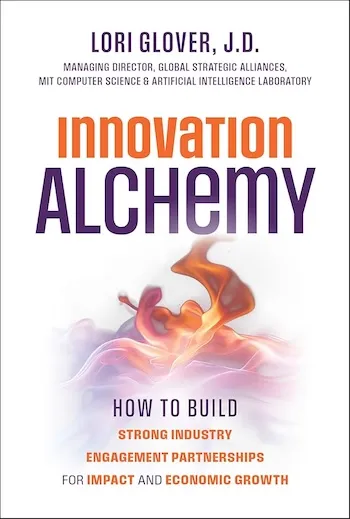
With the arrival of the Data Science Institute’s Lori Glover, however, Columbia researchers now have access to a dedicated and deeply experienced collaborator who literally wrote the book on how to build powerful—and mutually beneficial—academic/industry partnerships. In January, Glover officially joined Columbia, following more than a decade at MIT CSAIL, where she built the university’s second largest industry engagement program from the ground up.
Why would Glover leave such a successful program to start something new at Columbia? “At MIT, we didn’t have a medical school, or a law school, or a school of international policy and relations,” Glover says. When she learned of the opportunity to join DSI’s work supporting responsible data science and AI across the university, she says, “It just really struck me as an incredible opportunity to be able to build something with all of those different perspectives, because AI is in everything now. It’s exciting to be able to look across those disciplines and build something that is beneficial for all of them.”
Fortunately for both Columbia researchers,and future industry partners, Glover’s enthusiasm for creating strong alliances is exceeded only by her experience navigating the challenges they can present. Though she finds that both researchers and private companies are often keen to collaborate, “They don’t often understand the perspective the other is coming from.”
Want to learn more about Lori’s work and how your research group or company can become part of DSI’s new Strategic Alliances program? There are opportunities for research across all fields and companies of all sizes—including startups! Learn more about partnerships.
Openly addressing those potential differences is an essential first step. “Even the most basic differences can present a challenge. For example, [researchers and companies] have very different calendars,” Glover says. And while companies often focus on the need for competitive advantage and protecting proprietary information, “Everything in academia is ‘Share.’ So how do you reconcile those two incredibly different things?”
The key, Glover says, is understanding that there is no one-size-fits-all approach. “There are lots of different ways to move a relationship forward. It can be through startup companies, it can be through licensing technology, it can be through open source.”
“But,” Glover adds, “You have to have the conversations about what each party needs up front. In that process, trust is built. And trust is the foundation of any good relationship.” Crucially, Glover says, “It takes time.”
As a result, a key part of Glover’s approach is to start by working closely—and separately—with researchers and companies to understand their needs and their capacities.
For faculty, she says, this often requires “understanding how their research is applicable to challenges where there is no appropriate commercial solution [and] being able to translate it for industry.”
For companies, meanwhile, it may mean managing expectations around the often slow-and-then-fast realities of conducting novel research. “When you’re working with faculty,” she says, “it’s really not a good idea to have weekly status meetings.”
Having all parties coming to the table understanding that each collaboration is unique, however, is essential building partnerships that answer one pivotal question: “How do you get the research advanced at the university out of the lab and into the marketplace to make a positive impact?”